


Check Out Our New & Popular Books
"One God, One Mediator, One People" is now available in paperback in our store and other popular books and items.
Shop Now
"One God, One Mediator, One People" is now available in paperback in our store and other popular books and items.
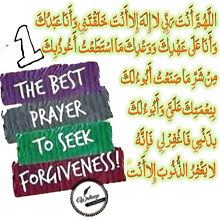
A Muslim friend and I were about to share our thoughts on sin and forgiveness in Islam and Christianity, but we were interrupted. Later that evening, he sent me the words of a prayer which he treats as the number 1 best prayer to seek forgiveness (See picture). Since it is recommended by the prophet of Islam, he recites it everyday. The translation is as follows: “O Allah, you are my Lord. There is no god but you. You created me and I am your slave. I am abiding by your covenant and promise (to follow) as best as I can. I seek refuge in you from the evil I have committed. I acknowledge your favor upon me and I confess my sin. So forgive me because no one forgives sins except you.”
This prayer is mentioned several times in the books of traditions with some variations. My Muslim friend asked me if Jesus recommended anything like this or if Jesus prayed for forgiveness for the sins of his followers.
The Qur’an features Moses’ confrontations with Pharaoh 27 times in the first 89 of its 114 chapters. However, not even once in the exodus saga accounted in the Quran is there any mention of the Passover. Readers of both the Bible and the Qur’an soon find out that although there are passages in the Qur’an that refer to the laws of Moses (directly as well as indirectly), the subject of sacrificial law, the offerings, and their purpose has been avoided. The Qur’an completely ignored the tenth sign God gave Moses, stating that God “had certainly given Moses nine evident signs” and then, tongue in cheek and in the same breath, tells the reader to go and “ask the Children of Israel” (Sura 17:101).
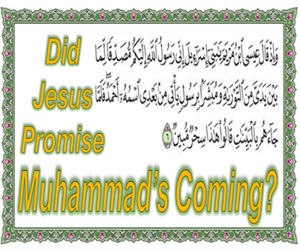
Muslims believe that one of the important features of Jesus’ mission was to give the ‘glad tidings’ of the coming of the Prophet Muhammad. According to the Qur’an, Jesus said, ‘O children of Israel! I am the Apostle of God (sent) to you, confirming the Law (which came) before me, and giving glad tidings of an apostle to come after me, whose name shall be Ahmed’ (Surah 61:6). ---So why do Christians believe that the promise is not about Muhammad but is about the Holy Spirit?

In Islamic theology, the terms kitman, taqqiyya / tuqya, etc. stand for telling a lie, concealing the true intention or misleading for a greater purpose. In general, Muslims have used it since the 7th century to confuse and split their enemies. A favored tactic is “deceptive triangulation” to persuade the enemy that Jihad is not aimed at them but rather at another enemy. It also refers to how a Muslim may lie, mislead or avoid truthfulness to achieve a purpose if the goal is for the benefit of the Muslim community.

The Bible is Changed – Really?
Some Muslims believe that Christians have corrupted the Bible, whereas their book, the Qur’an, upholds the same Bible, treating it as the word of God.
God revealed them
The Qur’an uses the following terms to refer to parts of the Bible: -
Tawrat – Torah, the first five books of the Bible
Zabur – the Psalms
Injil – the Gospel
Saha’if – the books of the prophets
The Tawrat, the Zabur, and the Saha’if are known as the Holy Scriptures of the Jews. Christians call them the Old Testament. The Injil referred to as the Holy Scriptures of the Christians is the New Testament. The Qur’an accepts them as God’s revelation: ‘... confirming that which was (revealed) before it, even as He revealed the Torah and the Gospel’ (Sura 3:3).