
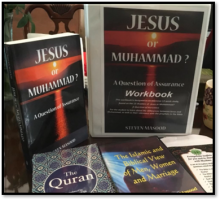
This study is based on Steven Masood’s book ‘Jesus or Muhammad: A Question of Assurance.’ The goal is to show that Jesus is the answer and not Muhammad to the Question of Assurance of eternal life. In the face of modern movements that are preaching ‘co-exist’, it is becoming more important for Christians to know about Muhammad and what the Qur’an and traditions of Islam say about him and of Jesus and the prophets of the Old Testament.
We examine how believers in the Bible and the Qur’an use a very different dictionary for vocabularies such as ‘peace’, ‘love’, ‘grace’ and ‘mercy’. We go into the detail of how both the Bible and the Qur’an with some key differences present the story of creation and the patriarchs; from Adam to Noah, Abraham to Jacob, from Moses to David and ultimately to Jesus. While the Bible stops with Jesus, the Qur’an continues to bring Muhammad on the scene. In such a setting, we deal sensitively with questions like:
- Is the Qur’an the continuation of the Bible?
- Did Jesus promise the coming of Muhammad?
- Is it Jesus or Muhammad as the final ‘messenger’ with the authority of assurance from God?
- What is the guidance that was promised to Adam to restore him and his progeny back to the paradise of God?
- If Jews, Christians, and Muslims believe in the same God, why do we find two different messages between the Bible and the Qur’an for the “last days”?
This study will strengthen your faith in Christ and the assurance of eternal life He gives. Second, this knowledge will be of great use to you in sharing your faith in Christ with Muslims when an opportunity comes, so you are ready for their questions including their objections.
The book including a work book, a copy of the Qur'an in English and other resources as student pack is available here.
INSTRUCTIONS
Watch a video (around 30 minutes) listed below, read the related chapter in the book, and answer questions and fill in the blanks in the workbook for that chapter. If you would like us to check your responses and fill in the blanks, let us know and we will be glad to compare it with our Teachers Key responses and fill in the blanks. The following intro video makes the mater much clear.
When a question or comment comes to mind, write them down. After the video or when possible send us those questions and comments by e-mail.
You may click on Contact at the top of this screen or click here. Type your comments or questions and Steven will respond within 24 hours.
A cursory look at their lives, their teachings and mission in the light of the Qur'an and the Bible. If both are from the same God, why are there key messages different?
The Bible and the Qur'an stand for the creation of God. However, there is a crucial difference in the accounts. The Bible mentions the preexistence of Jesus and how God created everything through him. The Qur'an does not mention this aspect of Jesus. Also nowhere do we find that God created the universe through Muhammad. There are some later sources in Islam which claim that the first thing God created was the light of Muhammad and then everything was created from this light. If that is the case why the Qur’an, the firsthand authority for Muslims does not mention it? If the God of the Bible and of the Qur’an is the same as Muslims believe then why are their differences? Why do Muslims prefer the Qur’an over the Bible?
Both the Bible and the Qur’an refer to Adam and Eve’s disobedience and their exit from the Garden of Eden. While the Qur’an refers to the rescue being just the guidance (the dos and don’ts), the Bible makes it clear that God has sent Jesus as the second Adam, to be the restorer of the covenant and the source of the gift of eternal life for you and me.
Both the Bible and the Qur'an accept Abraham as a prophet of God and as his Khalil - friend. However, the Bible and the Qur'an disagree concerning Ishmael, his whereabouts, the promise of God and other key details. While the Bible repeatedly assert that only Isaac is deemed the divinely elect son, Islamic traditions refer to Ishmael as the promised son. The Bible refers to a great sacrifice that Christians see fulfilled in Jesus (John 8:56). Islam presents that Muhammad is the eventual fulfillment of the promises made by God.
When we compare the Biblical account with the Qur’anic narrative about Moses and his leading the Israelites out of Egypt are different in some crucial points. The key event or sign was the Passover. We find that not only the Qur’an ignores the Passover; it also avoids naming Jesus as the Passover. Aaron’s priesthood and the tabernacle and the sacrifices are not mentioned in the Qur’an at all. Instead the Qur’an dwelt more on the commandment of Sabbath and how God punished them and turned some of them into apes and pigs. For Christians indeed Moses is important and so are the commandments and how they are fulfilled in Jesus.
Muhammad had a great desire to associate himself with the great prophets and kings of Israel. However, at the same time he tried his best to place himself as the greatest and final prophet of the same God so to persuade Jews and Christians of his claim. He mostly desired to secure credibility with his own people. Thus, he embedded into the Qur’anic narratives, the stories of three Israelite kings to motivate Muslims to stand with him, choosing him as the leader ordained by God. He claimed to have received whatever is in the Qur’an as verbatim from God through Gabriel. This begs the question that if it is the same God then why the narratives of these kings are contradictory when compared with what we find in the Bible?
In the Qur’an after Abraham (Ibrahim) and Moses (Musa), Noah (Nuh), Lot (Lut), Job (Ayub), Joseph (Yusuf), and Jonah (Yunus) are mentioned as prophets with significant detail. Muhammad used narratives to warn his people that if they did not listen to him, the same calamities will come over them. The student of the Bible quickly becomes aware that the Qur’an takes just one corner of each story from the Bible and builds a whole different account on it – with the attention being given to Muhammad instead of Jesus. The eventual underlining is to show that the climax is not Jesus but Muhammad.
Many Muslims in their writings and discussions quote from the books of the Prophets like Isaiah, Psalms and even Songs of Solomon in attempt to prove that the coming of Muhammad is prophesied in them. We show from some of the key prophecies they quote are really about the coming of Jesus and not Muhammad.
Does the passage, Deuteronomy 18:15-18, refer to Muhammad? If not, why not? Muslims claim that not only Moses prophesied the coming of Muhammad but Jesus too mentioned the coming of Muhammad as in John Chapters 14,15 and 16. We find that the context of these passages shows that Muhammad is not prophesied as a prophet from God in the Bible. The prophecies in Deuteronomy and the books of the Prophets do not refer to Muhammad but to Jesus. The promise in the Gospel according to John is not about Muhammad but about the Holy Spirit.
90 verses spread across fifteen chapters in the Qur’an refer to Jesus. The real purpose of Jesus being sent as Savior / Redeemer is absent from the Islamic teaching. Jesus is not divine. He did not die, nor resurrected. According to Islamic traditions, He will come again as an aid to establish Islamic rule. The Qur’anic gospel about Jesus has flaws and its scattered pieces do not fit in the picture frame the Bible has. Jesus is not coming back to establish a united state of Islam for Muslims, but he is coming for those who are his and to establish the new heaven, the new earth and the new Jerusalem (Revelation 21).
Islam uses a vocabulary like that of the Bible. Judgment, hell, paradise, love grace, mercy, and forgiveness are familiar words. However, Islam has its own dictionary. For example, God is loving but in Islam it is I who must take the initiative by keeping all the commands and then in return perhaps He will love me. In contrast, the Bible states before we loved Him, he has loved us. According to the Bible Jesus is the only hope of assurance. Muhammad does not give a Muslim assurance in this life about the hereafter whereas Jesus does. Muhammad does not know about what will happen. Jesus knows.
Islam uses a vocabulary like that of the Bible. Judgment, hell, paradise, love grace, mercy, and forgiveness are familiar words. However, Islam has its own dictionary. For example, God is loving but in Islam it is I who must take the initiative by keeping all the commands and then in return perhaps He will love me. In contrast, the Bible states before we loved Him, he has loved us. According to the Bible Jesus is the only hope of assurance. Muhammad does not give a Muslim assurance in this life about the hereafter whereas Jesus does. Muhammad does not know about what will happen. Jesus knows.